So I've been in Vietnam for 2 months now as an intern with Roots of Peace. It's been a unique experience, living with Tucker Kuhn, the ROP Vietnam Country Director, accompanying him to visit the offices in Binh Phuoc and Quang Tri, and--most of all--getting to meet the cacao and black pepper farmers. In January I made two trips to the ROP SHADE (Sustainable Horticulture and Agriculture Development) in Binh Phuoc--once with my sister, Katrina, who took photos for Roots of Peace--and again with Tucker and Gary Kuhn, Executive Director of Roots of Peace. Both trips involved some hot temperatures, washed out red dirt roads, and, of course, lots of smiles.
Mrs. Nguyễn Thị Ghim was so eager to show us her cocoa pods and family farm. Thanks to higher earnings from cocoa production, her family is starting to grow asparagus--a brand new crop in this area (Bù Gia Mập, Binh Phuoc).
After visiting several cocoa farms, ROP staff, my sister, and I were invited to share a meal at the home of Mr. Nguyễn Văn Hiền, Club Leader. Every time we visit farmers and their families, we are invited to tea or a meal. In this case, the Club Leader invited us to come and stay in his home. Amazing hospitality!
ROP involves the Vietnamese government's agriculture department in their work in order to reach as many farmers as possible and provide excellent agricultural training and assistance. This helps to build the foundation for cacao production in Binh Phuoc that is sustainable in the short- and long-term. During Gary's recent visit, we met with the Binh Phuoc Agriculture and Aquaculture Extension Committee (AAEC). Here, Mr. Nguyễn Quang Ngân, ROP Project Manager (in the striped shirt), discusses plans for ROP and AAEC collaboration in 2012.
ROP's cocoa project works with established cashew farmers since cacao needs shade--75% as seedlings and at least 50% as mature plants. Pictured here are one-year-old ROP seedlings in Mr. Nguyễn Tất Nhân's farm (Bù Gia Mập, Binh Phuoc).
Binh Phuoc Province is the epicenter of cashew production in Vietnam. Cashew trees tend to flower in the dry season--but if it rains after the trees flower (as it was during our visit), fungus and mildew results. Hence ROP's SHADE Cacao Project provides cashew farmers with a "safety net" by helping them diversify their agricultural production.
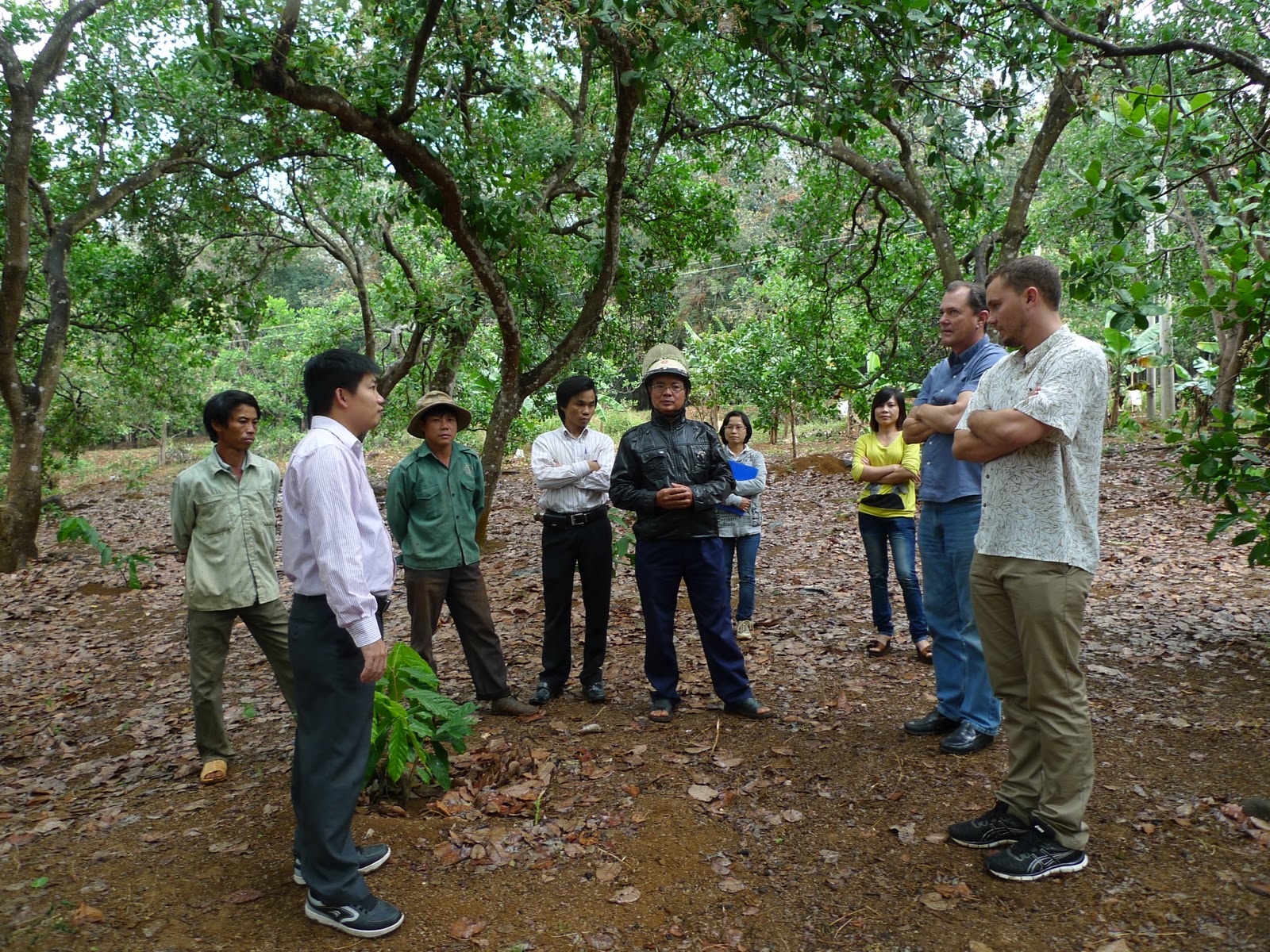
The ROP SHADE Cacao Project works with Club Leaders that are trained by AAEC staff and provide advice and support to ROP cacao farmers in their area. Here, Gary and Tucker (far right) compliment farmer Nguyễn Tất Nhân (in the dark green jacket)--and, by extension, Club Leader Kiều Văn Thái (in the black jacket)--on his beautiful cashew and cocoa farm (Bù Gia Mập, Binh Phuoc).
Ms. Nguyễn Thị Mơ, ROP Extension Advisor, stands next to a two-year-old ROP cacao seedling to demonstrate how ROP cocoa farmers are growing success!
I'm behind on my blog because...well, I've been busy learning a lot and having fun! I'm keeping a journal of my activities, so what follows is a run down of my week in Quang Tri where Roots of Peace has a black pepper project.
December 1, 2011
Visited 3 districts, Huong Hoa, Cam Lo, and Vinh Linh. We stopped at the Khe Sanh Combat Base museum and got a bit of history along the way.
Visit to the museum at Khe Sanh Combat Base. According to Lonely Planet "The site of the most famous siege--and one of the most controversial battels of--of the American war...Despite the fierce fighting and loss of life, Khe Sanh was probably never the North's real target, but merely a diversionary gamble in preparation for the Tet Offensive."
"About 500 Americans, 10,000 North Vietnamese troops and uncounted civilian bystanders died amid the din of machine guns and the fiery explosions of 1000kg bombs, white phosphorus shells, napalm, mortars and artillery rounds of all sorts."
Lonely Planet: "Khe Sanh Combat Base was never overrun, but it was completely stripped and dismantled before the Americans left...Today the site is occupied by a small museum, a few captured or downed American aircraft and a red dirt swathe where the airstrip used to be."
ROP’s black pepper project is in Vinh Linh, but they’d like to expand it to Cam Lo. Saw coffee and black pepper in Huong Hoa. Met with government officials from DARD (Department of Agricultural and Rural Development) and officials of the People’s Committee in each district. We were brought into the official meet-and-greet rooms of the District Headquarters, served tea and water, and introduced to the officials. Tucker and the officials then exchanged pleasantries and promises for support. Officials in Vinh Linh said they would set up a low-interest loan program similar to one in Cam Lo.
Arabica coffee in central Vietnam! Only about 3% of Vietnamese coffee is arabica--the rest is robusta, which grows at a lower altitude, is easy to maintain, and contains more caffeine.
Coffee and black pepper intercropping (the black pepper vines grow on the tall trees)
A warm greeting from government officials in Cam Lo
beach break
a break in the clouds
December 2, 2011
Attended ROP TOT (“Training of the Trainer”) in Vinh Linh in the morning. There were about 20 people there (2 of whom were women). These are club leaders, model farmers, and demo farmers who will train other farmers in black pepper best practices. This was the second training of this sort. Dr. Truong (the black pepper expert from Hue) divided the attendees into groups and had them draw plants and the problems. He then had different people present to the group. We then went to a farmer’s house and looked at samples he was keeping of leaves and the group talked more about techniques and issues.
black pepper vines and peppercorns
Club leaders attend this workshop with a black pepper expert, Dr. Truong, to learn about pests and proper growing techniques. They will then be able to help the farmers in their clubs.
club leaders present about different diseases that affect black pepper vines
Tucker and Lien (Roots of Peace staff Quang Tri) talk with a club leader.
Tucker and Binh, Roots of Peace staff Quang Tri, answering questions from club leaders and thanking them for all their work.
Afterwards we were invited to pay our respects at a club leader’s home. His mother, 88, had just passed away. We entered the home, saw the shrine, were given an incense stick, bowed three times, and placed the incense stick on the altar. We then had tea with the couple. The woman wore a white band around her head—a sign of mourning. Both the club leader and his wife were obviously grieving—they smiled when we talked with them, but you could see deep sadness in their eyes.
We then traveled back to Dong Ha and Binh invited us to his brother’s home for lunch. The whole family was there—it was his older brother’s death anniversary. Everybody gets together, the women cook a lot of delicious food, and the men sip beer and reminisce. I felt honored to be invited to this family gathering.
Binh (3rd from left) and his family
Then we headed down to Hue (asking our driver to book it—he did a 2+ hour trip in less than an hour and a half) to catch our flight to Ho Chi Minh City.
All in all, it was a great week in Quang Tri and I know more about black pepper than ever before. Having seen the work Roots of Peace is doing first hand, I can better appreciate the organization's work to help farmers earn higher incomes through black pepper. It doesn't take up a lot of space, can easily be intercropped with other produce, and fetches a good price on the market. By providing training to club leaders and farmers, ROP is helping to provide knowledge and inputs that help to create a quality product. It makes sense!
Tucker and I left the bustle of Ho Chi Minh City yesterday and headed up to the Roots of Peace Quang Tri office in Dong Ha.
According to Project RENEW: "Quang Tri Province was the site of many of the most devastating battles of the American war, from 1966 to the end of the war in 1975. The province was also subjected to one of the heaviest bombing campaigns in the history of the world. The amount of munitions poured onto the landscape and villages of Quang Tri totaled more than all the ordnance used in Europe during World War II." http://www.landmines.org.vn/where_we_work/quang_tri_province.html "Quang Tri still suffers the highest contamination of bombs and mines of any place in Vietnam. Contamination is found on more than 80 percent of the province’s land area (average contamination nationwide is 20 percent). Since 1975, the province has recorded 7,075 casualties due to ERW accidents, about 1.2 percent of its total population, including 2,635 deaths. Notably, 31% of the victims have been children." http://www.landmines.org.vn/news/NPA_Quang_Tri_government_commit_two_million_nine_hundred_USD_to_reduce_UXO_accidents.html
Roots of Peace has a black pepper project here, working with small farmers seeking to grow a high-value crop in areas that have been de-mined.
Hue from the plane
After landing in Hue, we took the shuttle into town from the airport and had dinner at a "French" restaurant. The calamari was absolutely delicious, as well as my mango and yogurt shake, ham and cheese crepe, and lemon tart. A little bit after eating, however, I started feeling little pin pricks on my upper arms. I hoped it was just psychological and tried to put it out of my mind.
The calamari culprit (?)
We then headed to the railway station to catch the train to the ROP office in Dong Ha. It cost 40,000 dong per person ($2) for a soft seat in the A/C cabin.
Ok, so we know which direction we are heading...
Upon boarding our car, I was immediately invited to sit down next to an older man who was quite drunk. He kept patting the empty seat next to him and pointing at me, grinning ear to ear. Luckily you are assigned seats when you buy your ticket and mine was out of his reach. After we got moving, he started talking loudly on his mobile and smoking (in a non-smoking a/c cabin). Charming.
I didn't take too many photos on the train since I didn't want to look like the three weather-worn backpackers videotaping the bathrooms and snapping their flash. But I did get this one, and it pretty much sums up my experience (albeit short) with train travel in Vietnam:
See that man on the left with his leg on the empty chair? That could have been my throne...
We arrived in Dong Ha, met up with the only other expat in town and his coworker, had some beers, and went to bed. I woke up this morning to this:
Exhibit A
So, who knows what caused it--Calamari? Bug bite? All I know it's itchy as hell. Tucker and myself and the two Roots of Peace staff here, Binh and Lien, attended a 4 hour lunch with local government officials. (Otherwise known as "networking"). After the first beer the itching got worse, so I switched to Coke. About two hours into the lunch, Binh appeared with toothpaste and told me to slather it on my arms. Amazing relief! And he also had a neighbor lady prepare a strong green tea for me to wash with. I could feel my skin "shrinking", but it seems to be helping a bit. Whatever happens, don't give me any sandpaper as I might be tempted to use it.
I'm back in Ho Chi Minh city after a week up in Bình Phước Province. It's exciting to be back in the city--and also a little scary. I didn't have to worry about getting run over in Đồng Xoài, where the Roots of Peace office is. Yes, there was traffic, but nothing like HCMC.
The first week of my internship involved getting to know the folks in the Bình Phước Province Roots of Peace office: Tucker, the Country Director, Son and Mo, the Extension Agents, and Em Anh, the driver.
Eating lunch with Tucker, Sun, and Mo Em Anh monkeying around in a cashew tree
World demand for cocoa is up and international traders like Cargill are pushing for more production; thus countries like Vietnam are jumping on board. Roots of Peace works closely with government agencies that are involved in the push for cacao production. The Sustainable Horticulture and Agriculture Development Pilot (SHADE) Project works with around 840 cacao farmers and began distributing cacao seedlings 3 months ago. All the farmers selected had fully grown cashew trees, which provides good shade for the cacao trees. There is a club leader for every 20-30 farmers in the project within a certain area. The club leader keeps tabs on how the cacao is doing and acts as a liaison with Roots of Peace and the government agricultural agency. Roots of Peace is focused on capacity building (giving more responsibilities to the government, club leaders, and farmers) and training for farmers to produce quality cocoa.
After I received clearance from the government, I was able to go out into the field with Tucker, Son, Mo, Em Anh, and government extension agents to do some M&E. (That's Monitoring and Evaluation for those of you who, like me, aren't familiar with development acronyms). We visited 2 different clubs and saw 6 different cacao farms. Most were doing well--and some had plants from previous government projects that were already producing cocoa pods.
On the red dirt roads
Mo interviewing a female farmer
Mo demonstrating just how tall cacao plants can grow...
This is where your chocolate comes from
It was great to see the cacao plants up close and meet the cacao farmers. It was, however, also very hot and luckily I didn't drink too much water--not sure where I would have had a bathroom break! (Men can squat wherever--but not women).
And after a long half day in the sun, we attended the weekly "working dinner" with local officials. This is "networking" at its finest. It involves meeting at a restaurant, bringing a case (or 2) of Heineiken (rice liquor if you're in the north), and eating, drinking, and more drinking. There is quite a bit of toasting that goes on--involving everyone at the table, the person next to you, the respected guest, or even the waitress. There's a cheer which challenges the other person/people to drink their whole glass ("tram phan tram" or 100%). Women are allowed to go "nam muoi" (50%). I earned the respect of many men at the table by doing a few 100%ers, but I knew my limits. I also gained a few admirer who showered me with compliments as the time passed: "Miss Summer, you veeery veeery beautiful"...and friendly, and nice, and tall, and so on and so forth. It was a lovely self-esteem boost. And I know, that should I get lonely in Vietnam, I have a few suitors just waiting for me to call.